
How Is Embodied AI Transforming Humanoid Robotics? (Vision-Language-Action Models)
An engineering analysis of modern humanoid robots (Figure 02, Boston Dynamics Atlas, Tesla Optimus): how end-to-end Vision-Language-Action (VLA) models and whole-body reinforcement learning replace rigid pre-programmed kinematic trajectories.

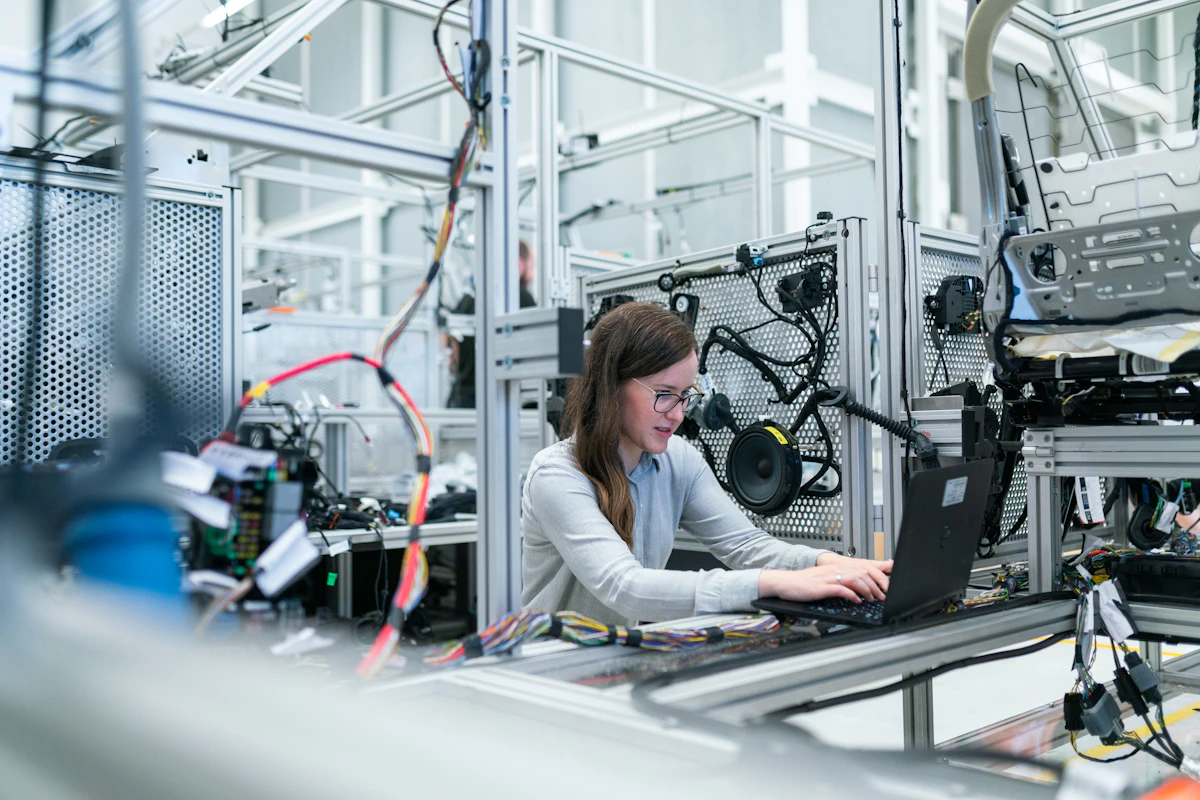
The Death of Hardcoded Kinematics: The Emergence of Embodied AI
For decades, industrial robotics relied entirely on rigid, deterministic control algorithms: engineers pre-programmed exact joint coordinates in highly structured factory cages [1,2]. If an object moved by a single centimeter or a human entered the workspace, the robot failed or caused damage [1,2]. This illustrated Moravec’s Paradox—the observation that high-level abstract reasoning is computationally easy for computers, but subconscious sensorimotor physical skills (walking, grasping an apple without crushing it) are extraordinarily difficult [1,2,3].
Embodied AI bridges this gap by grounding large multimodal neural networks directly in physical sensors and robotic actuators [1,3,4]. Modern humanoid platforms—including Figure 02, Boston Dynamics’ all-electric Atlas, Tesla Optimus Gen 2, and Sanctuary AI Phoenix—replace brittle kinematic equations with end-to-end foundation models that learn generalizable manipulation and locomotion directly from data [1,3,4].
"Embodied AI solves Moravec’s paradox by replacing rigid pre-programmed kinematic code with neural foundation models that adapt to dynamic real-world environments."
Vision-Language-Action (VLA) Models: From Pixels to Motor Torques
The core software revolution driving modern humanoids is the Vision-Language-Action (VLA) model, pioneered by Google DeepMind’s RT-2 (Robotic Transformer 2) and open-source models like OpenVLA [1,5].
A VLA model takes visual camera frames and natural language instructions ("Pick up the red apple and place it in the metal bowl") as input [1,5]. Instead of outputting text words, the transformer tokenizes continuous physical actions: 6-degree-of-freedom end-effector positions, gripper open/close states, and joint motor torques at 20 to 50 Hz [1,4,5]. Because the model inherits broad world knowledge and common-sense reasoning from internet-scale pre-training, it can generalize to unfamiliar objects, lighting conditions, and tools without explicit retraining [1,4,5].
"VLA models output continuous joint torques directly from camera pixels, allowing robots to manipulate novel objects using common-sense reasoning learned from pre-training."
Sim-to-Real Transfer & Whole-Body Reinforcement Learning
Training a physical bipedal humanoid through trial-and-error in the real world is dangerously slow and expensive due to mechanical wear and falls [1,6]. To overcome this, roboticists use Sim-to-Real Reinforcement Learning in GPU-accelerated physics simulators (such as NVIDIA Isaac Sim, MuJoCo, and Genesis) [1,6].
In simulation, thousands of virtual humanoid agents train concurrently across millions of simulated hours in minutes [1,6]. By applying domain randomization—constantly varying friction coefficients, motor latency, payload weights, and push perturbations—the neural policy develops robust whole-body balance [1,6]. When deployed to the physical robot, the neural policy seamlessly transfers without falling, handling stairs, slippery floors, and sudden shoves effortlessly [1,6,7].
Actuation and Dexterity: The Quest for 20+ Degree-of-Freedom Hands
Human-level manual dexterity requires complex biomechanical hardware [1,3,4]. Modern humanoids are shifting from simple two-finger parallel grippers to anthropomorphic hands with 16 to 22 degrees of freedom (DoF), equipped with high-density tactile sensor arrays on every fingertip [1,3,4].
Platforms like Figure 02 and Tesla Optimus integrate high-torque-density brushless DC motors with planetary gearboxes and cable-driven tendons directly into the forearm, delivering both delicate 10-gram precision manipulation (threading a needle, picking up an egg) and 25-kilogram payload endurance [1,3,4]. As humanoid robots enter pilot deployments across automotive assembly lines (BMW, Tesla), the convergence of embodied foundation models and high-yield electromechanical actuators is laying the foundation for a multi-trillion-dollar physical labor transformation [1,2,4].
Key Chronology & Milestones
Honda unveils ASIMO, showcasing early bipedal dynamic walking using classical Zero Moment Point (ZMP) control.
Google DeepMind publishes RT-1, introducing transformer-based robotic control across 130 manipulation tasks.
DeepMind introduces RT-2 (Vision-Language-Action), translating internet-scale web pre-training into physical robotic actions.
Figure AI demonstrates Figure 01 running OpenAI multimodal vision-speech models for real-time natural language manipulation.
Boston Dynamics retires hydraulic Atlas and unveils the all-electric Atlas with custom high-torque actuators and 360-degree joints.
General-purpose humanoid robots deploy to commercial automotive assembly lines (BMW Spartanburg, Tesla Gigafactory).
Cited Primary & Academic Sources
7 Verified RecordsAnthony Brohan, Noah Brown, Justice Carbajal, et al. (Google DeepMind 2023) · arxiv.org
Seminal paper demonstrating that Vision-Language-Action foundation models enable emergent semantic reasoning and zero-shot tool manipulation.
Hans Moravec (Harvard University Press) · archive.org
Classic text formulating Moravec’s Paradox: why sensorimotor skills require vastly more computational resources than abstract logic.
Moo Jin Kim, Karl Pertsch, Siddharth Karamcheti, et al. (Stanford / arXiv 2024) · arxiv.org
7-billion-parameter open-source VLA model trained on the Open X-Embodiment dataset achieving state-of-the-art multi-robot control.
Figure AI Engineering (Figure AI Technical Reports 2024) · figure.ai
System design overview of Figure 02’s onboard compute, 16-DoF hands, speech-to-speech integration, and BMW pilot testing.
Open X-Embodiment Collaboration (arXiv 2023) · arxiv.org
Dataset encompassing 1 million robot episodes across 22 different robot embodiments, proving positive cross-embodiment transfer.
Marco Hutter Lab & ETH Zurich Robotic Systems Lab (Science Robotics) · science.org
Sim-to-real reinforcement learning framework proving robust zero-shot deployment of quadrupedal and bipedal locomotion.
NVIDIA Robotics Research (NVIDIA Technical Whitepaper) · nvidia.com
Technical overview of PhysX GPU simulation engine enabling millions of parallel environment rollouts for whole-body humanoid control.
Frequently Asked Inquiries
Click any inquiry to researchWhat is a Vision-Language-Action (VLA) model in robotics?
A Vision-Language-Action (VLA) model is a multimodal neural network that takes camera images and natural language instructions as input and directly outputs physical motor actions (joint angles, torques, and gripper controls) at high frequency, allowing robots to understand and interact with the real world adaptively.
What is Moravec’s Paradox?
Moravec’s Paradox states that tasks that humans find difficult (such as playing chess, doing calculus, or writing code) require relatively little computation for AI, whereas subconscious sensorimotor tasks that infants master easily (such as walking, balancing, and picking up arbitrary objects) require massive computational and perceptual complexity.
How do humanoid robots learn to walk without falling?
Modern humanoid robots learn to walk using Sim-to-Real Reinforcement Learning. In physics simulators like Isaac Sim, virtual humanoids practice walking across billions of randomized variations of rough terrain, slippery surfaces, and obstacles. The resulting neural balance policy is then transferred directly into the physical robot.
Research delivered once a week.
One deeply investigated historical, scientific, or economic mystery grounded in primary sources. Pure evidence, zero noise.
Explore the Question Graph
Every investigation opens further avenues of historical and scientific inquiry. Select a connected question to research it immediately:
Related Research Investigations


Have a question of your own?
Alcuin researches primary historical records, academic journals, and peer-reviewed archives with zero hallucinations.